Weaving a Future With Threads from the Past:
Reflections on the Possibilities of Education in the USA and Ghana
By Katherine Sorel
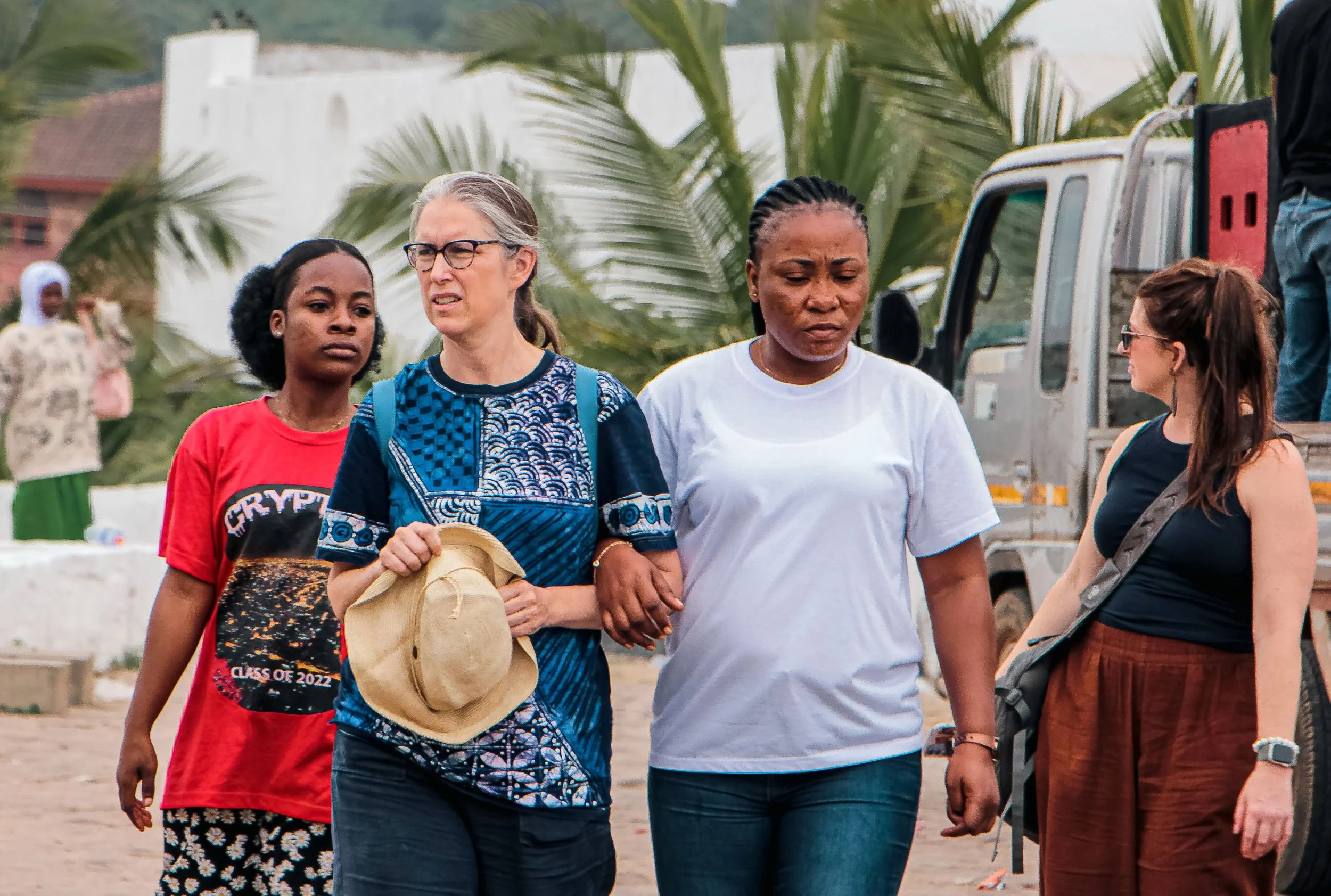
Like the rest of my American cohort, I was surprised and intrigued to hear the news, shared by Tete, that Ghana would begin to require schooling in students’ home languages rather than in English. This is clearly an extension of the movement that we learned about last summer from Elikim Kunitsor to create a new national curriculum that centers traditional knowledge and cultural practices. “Effective education requires the concept of Sankofa,” he explained. I was fascinated by this lecture because I had not previously considered how relatively young Ghana is as a nation or the ways the colonial experience might continue to live on in places such as schools. The lecture gave context to what we were hearing from our Ghanaian counterparts who seemed to each teach a different academic subject “and Creative Arts.” Phoebe, who teaches History and Creative Arts, explained the connection for her this way: “The arts are about tracing your roots so that’s how it connects to history.” Phoebe’s words crystallized for me my own goal: to immerse children in the Creative Arts of West Africa so that they appreciate what the enslaved West Africans brought with them to this country.
Meanwhile, while Tete was sharing this news from Ghana, I was wondering whether I was witnessing the end of democracy in the United States. The government had shut down; the Congress had relinquished their jobs; the Supreme Court was busy rubber stamping the actions of our autocratic president who seemed to be in the process of creating a private army to police dissidents. If the purpose of education in a democracy is to prepare citizens to participate in that democracy, and if the US became a democracy in name only, then what would be my role as a teacher? How could I blithely go to work each day as if everything is normal when it is not?
And then I thought about Ananse. In Ghana I was always asking the Ghanaians to tell me an Ananse story. Kofi asked me, “Why are you so obsessed with Ananse?” The answer is that I am fascinated by how these stories, created so long ago, survived the Transatlantic Slave Trade and all that came after on both sides of the Atlantic and continue to connect us across space and time. If the wisdom buried in those stories can survive simply by word of mouth, then perhaps we could keep a democratic vision alive. I thought about our American spider, Charlotte, who saved Wilbur (the pig) by weaving messages in her web in her corner of the barn. And I thought of what Olivia said in her interview with Nancy, “In our little, little corners, we are doing our best.” Thinking of that renewed my strength and resolve. I would do my best in my corner to continue to plant and nourish the seeds of a multi-cultural democracy, knowing that Kofi and Kristen were doing the same in North Carolina, Mady in Minnesota, and Melissa and Kiyah here in NY.
And then, as I was mentally preparing for the worst, Election Day came and people voted. In New York, we elected Zohran Mamdani for mayor. Zohran was born on a Friday, but his middle name is Kwame, after Kwame Nkrumah. Perhaps, after all, we will join Ghana in creating a future that honors the best of the past.