The Song Inside
I consider myself to be an earnest yet cynical person when it comes to the transformational nature of travel. I seek out new experiences and strive to absorb as much as I can. Still, how much can time spent away from home really change you? Perhaps it’s not the places but the people you spend time with who have the most impact.
When I applied to Witness Tree, I didn’t know anyone who had participated in the program. Although we met on Zoom, it was hard to tell how the group would coalesce. I felt shy at first, but quickly felt ease and trust with the cohort. When you are greeted with a band of drums, you have to dance a little.
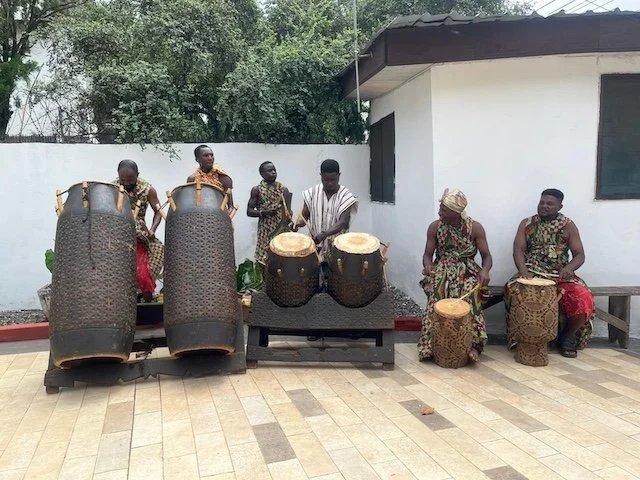
Something special happens when teachers connect outside of their normal routines. For two weeks – and two weeks only – we are all on Ghana time. Outside of school schedules and pressures of everyday life, we are free to find a new rhythm.
Dr. Kofi Antonio described the 3 C’s of dance: “Concentration, coordination, confidence.”
I couldn’t help but think how this motto could translate to other areas of learning and life. I can recall many times when students would say “I don’t do art” in class, thinking of the product over the process. I have tried many ways to ease the pull of perfectionism for my students, letting them know the point is expression itself. Building that confidence to be “okay” and work towards something takes time.
In our dance lesson, we learned a few short steps, then played a game trying to distract others and get them off beat. Failure was baked into the process and we had a blast. We could all use some low-stakes silliness in our lives.
Singing and dancing is not part of my day to day, unless singing alone in the car counts. I haven’t expressed my musical side with other people in a long time. With each new song or dance, I feel lighter. Like I am returning to a former version of myself. It made me thankful for my music education growing up.
When it’s time for my first solo on the bus, the song I once sang in harmony (well, close to harmony, let’s be real) escapes my mind completely. Nerves take over. Within a beat, the group steps up and gently guides me back to the song. All is well again.
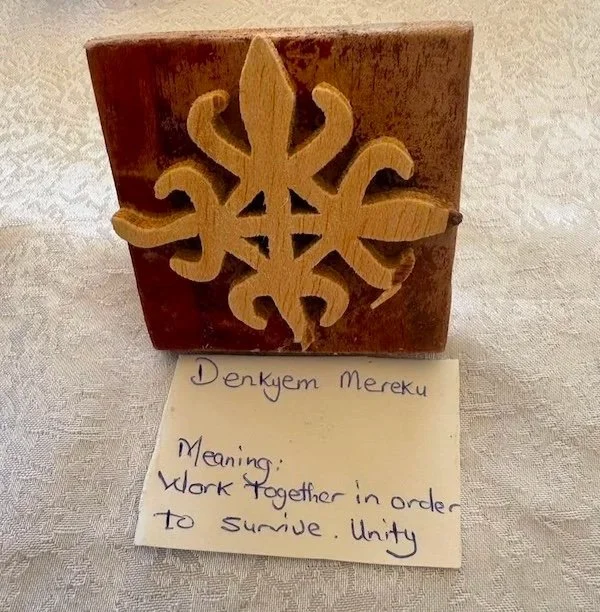
Reflecting on Adinkra symbols, I suddenly found myself leading the group in a sing-a-long of “Lean on Me” by Bill Withers:
Sometimes in our lives we all have pain
We all have sorrow
But if we are wise
We know that there's always tomorrow
Lean on me, when you're not strong
And I'll be your friend
I'll help you carry on
For it won't be long
'Til I'm gonna need
Somebody to lean on
This was a little out of character for me, but it felt like a full circle moment. The last time I performed the song was in first grade. Each child sang one line at an assembly. Twenty-plus years later, I am singing it again with great company in Ghana. Although our friendships are new, the sentiment rings true. I have seen countless acts of kindness and generosity from this cohort.
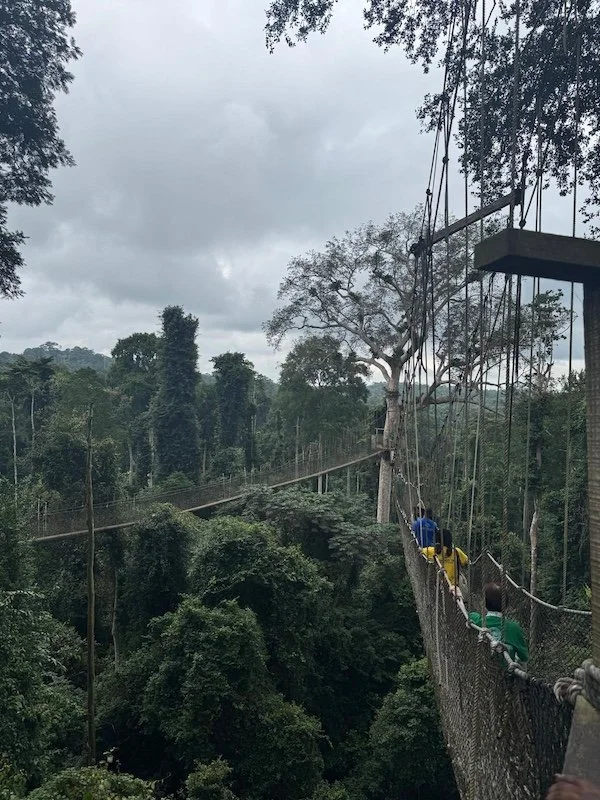
In a relatively short span of time, we have experienced highs and lows as a group. We took on the canopy layer of Kakum National Park, swinging as we walked across seven suspension bridges. One minute, we are confidently singing “Bring Your Kalabashi,” the next we are being chased by a horde of army ants out of the forest.
Together, we confronted the past at Cape Coast, Elmina, and Donkor Nsuo. The gravity of these places will continue to weigh heavily on my mind moving forward. I can only hope that we learn from this experience and take these lessons to heart at home. Like the dance goes, “plant the seeds today, harvest them tomorrow.”
Music seems to provide some comfort and a sense of normalcy in the aftermath, though a song is only a start. “The road will be muddy and rough.” “We shall overcome.” And the group favorite, “Bring Your Kalabashi,” has been stuck in my head all week.
Kristen Waltz teaches 6th and 7th Grade World Civilizations in the University Scholars Program at PA Leadership Charter School in West Chester, Pennsylvania, USA