Every Person Is a Story Waiting to Be Heard: Why Storytelling Makes Us More Human
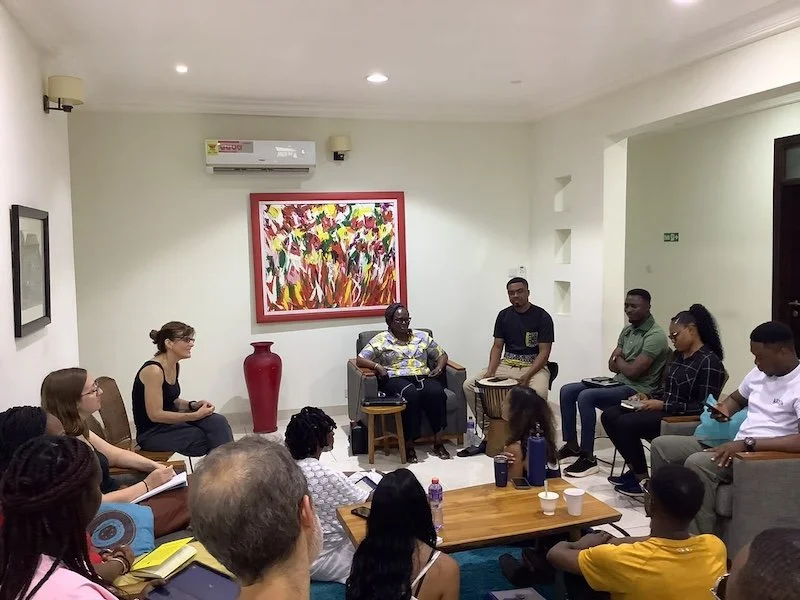
"The greatest stories are not always found in books. They are found in people."
Every person we meet carries a story. Some stories are shared openly, while others remain hidden behind smiles, silence, and ordinary conversations. We often judge people by what we see on the surface, forgetting that every face has journeyed through valleys and storms, celebrated victories, endured disappointments, and displayed extraordinary courage.
One of the greatest lessons life has taught me is this: until we come close enough to people, we may never know the battles they have fought or the victories they have earned.
This is why storytelling matters. Stories are more than entertainment. They preserve memory, teach values, build empathy, and remind us that hope often takes root where despair once lived. Many stories begin with pain and uncertainty, leaving us wondering whether they will ever have a joyful ending. Yet, as they unfold, we often discover that healing comes through another human being who chooses to care.
One remarkable example is Mrs. Gertrude Oforiwaa Fefoame, a Ghanaian woman whose life changed dramatically at the age of eleven. She gradually lost her sight because of an eye condition. Although she received support from family, she also encountered people who believed her blindness had ended her future. As a young student studying science, she had dreamed of a career in the scientific community, but those dreams suddenly seemed beyond reach.
But one person refused to accept that narrative. A friend named Grace believed in her when many others did not. Grace became more than a companion; she became a source of hope. “Sometimes all it takes is one person to say, "You can," when the world is saying, "You cannot." “ she said. That simple encouragement became a turning point in her life.
Today, Mrs. Gertrude Oforiwaa Fefoame is internationally recognized for championing the rights of persons with disabilities. Her life reminds us that disability does not define destiny. More importantly, it demonstrates how one person's encouragement can redirect another person's future. Her story beautifully illustrates what many call Gracious Space—creating environments where people are welcomed, respected, heard, and empowered to become their best selves.
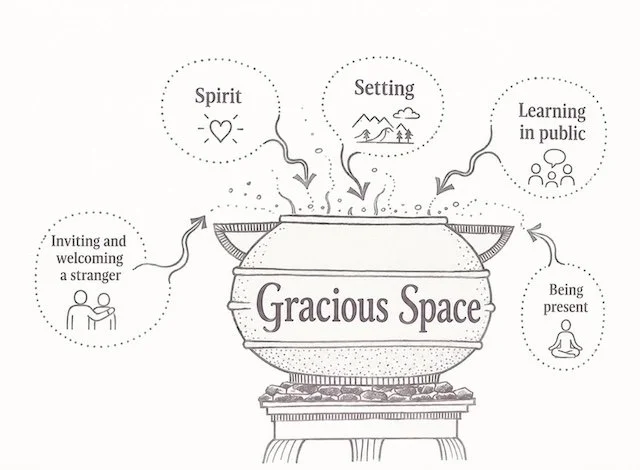
Drawing by Emily Williamson
I recognize that the five elements of Gracious Space come alive in the telling of Mrs. Fefoame’s story-
Spirit reminds us that every human being possesses inherent worth. Grace saw ability where others saw limitation. She chose compassion instead of pity and hope instead of despair.
Setting teaches us that environments shape human growth. When communities create spaces where everyone belongs—regardless of disability, background, or status—people flourish rather than merely survive.
Learning in Public calls us to humility. Listening to another person's story challenges our assumptions. We become students instead of judges, discovering that wisdom is found not only in classrooms but also in lived experience.
Inviting and Welcoming the Stranger asks us to embrace those whose lives differ from our own. Often, a stranger is simply someone whose experiences we have never taken the time to understand. Inclusion begins when we intentionally make room for others.
Being Present may be the greatest gift of all. Presence means listening without rushing, encouraging without controlling, and walking beside someone through difficult seasons. Grace did not simply offer advice; she offered companionship. Often, people need someone who will stay with them before they need someone to solve their problems.
These principles are not merely theories. They are practical expressions of our shared humanity.
This is why storytelling remains one of humanity's greatest gifts. Stories transform statistics into people, history into memory, and strangers into neighbors. They remind us that behind every achievement lies sacrifice, behind every smile may be hidden tears, and behind every ordinary person may be an extraordinary testimony waiting to be heard.
The work of Witness Tree Institute Ghana reflects this same philosophy. By preserving and sharing the stories of Ghana’s glorious past and history-resilience, reconciliation, and human dignity and also the dark version of the trans-Atlantic slave trade, the Institute creates space where people from diverse backgrounds gather not simply to learn history but to encounter our shared humanity. We are invited to listen deeply, reflect honestly, and leave transformed by voices that might otherwise have been forgotten.
Our stories have the power to heal, educate, and inspire future generations. Every program, ceremony, and conversation encourages participants to look beyond differences, honor our present , acknowledge painful histories, and embrace our common humanity.
Perhaps the greatest lesson is this: every person deserves to have their story heard before they are judged.
Every conversation is an opportunity. Every stranger is a potential teacher. Every act of kindness can become the turning point in someone's story. And perhaps, somewhere, someone is waiting for us to become the "Grace" in their own journey. Each time we choose compassion over judgment, welcome over exclusion, or presence over indifference, we write a new chapter in the human story.
I think in the end, storytelling is not simply about remembering the past or entertaining people. If we are intentional about how and where we share our stories, how well we listen to them, we would in the end, be creating a more compassionate future—one story, one listener, one gracious space, and one life lesson at a time.
Ama Acheampong teaches English Language and Religious & Moral Education at the Nyigbenya D/A Basic School, Ada, Greater Accra,