Lessons from Ghana
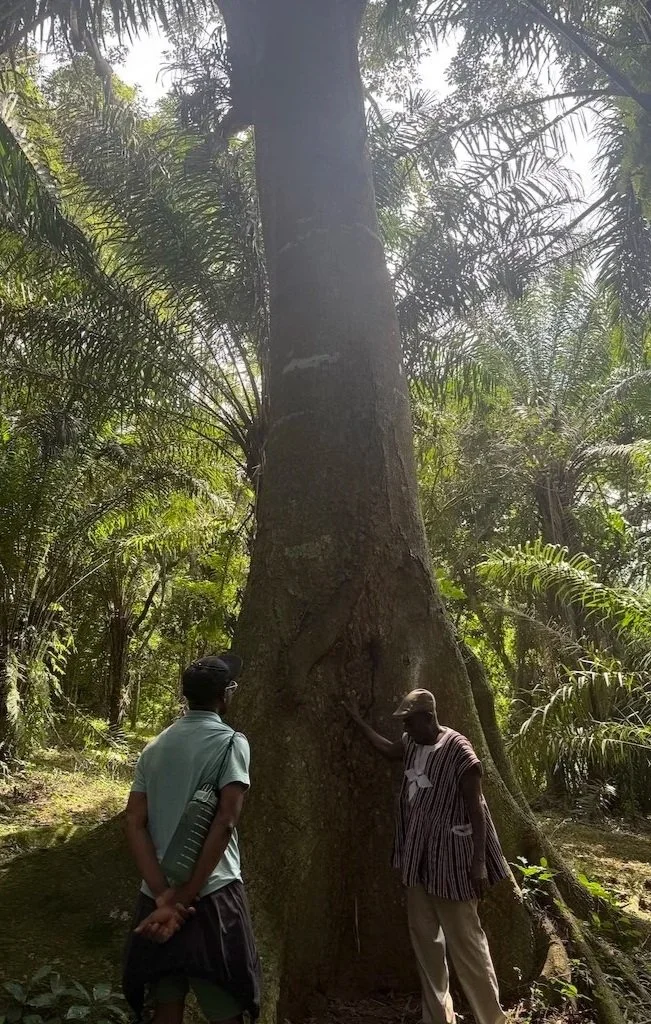
Professor Obeng talks about the Dantu tree at Ananse kwae , Mampong, Akwapim
We stood by the Dantu tree, with our ear against its majestic trunk.
“Listen to the tree. Hear what it has to say,” Professor Pash instructed us.
Since arriving in Accra, we have listened.
We have listened to the stories and lectures that showed us what it looks like to create narratives collaboratively across oceans, allowed us to reflect on our own spirituality and identities, and led us to question a conventional “blackboard” education.
We were reminded that a true, wholesome education is a lot more than just the books we’ve read; a true education extends beyond the walls of the schoolhouse. Ghanaian children learn by playing games like Tumantu with friends, working alongside a parent at the market or farm, or creating traditional crafts that demonstrate their values and honor their rich culture.
We have danced and used our bodies to tell the story of African people going into the woods, brushing away harmful principles, and planting the seeds for future generations to grow.
We have listened to the lyrics of classic Ghanaian songs and sung the words that reassure us: “It can be hard, we know, and the roads can be muddy and rough, but we’ll get there.”
We heard seventh grade students excitedly chatter amongst our presence in their classrooms. During time for questions, one student stood up in his green school uniform and asked, “Is there a lot of crime in the U.S?” His question gave me perspective, and I could not help but mentally compare the two countries.
The United States which claim to be the land of the free yet keeps people in the chains of which their ancestors wore upon their arrival.
The United States, which continues to abuse power to beat and oppress African Americans and people of color.
The United States which has threatened to change its history to support a false narrative and fail to take accountability for its past transgressions.
The “United” States which divides people and breaks apart families, whether through physical force or differences in political ideologies and beliefs.
The United States which does not welcome the stranger, as Ghana does, and casts them out as if they are not mothers, fathers, daughters, and sons.
The United States, within its young 250 years as a nation, has much more to learn, and should enroll in some lessons from Ghana.
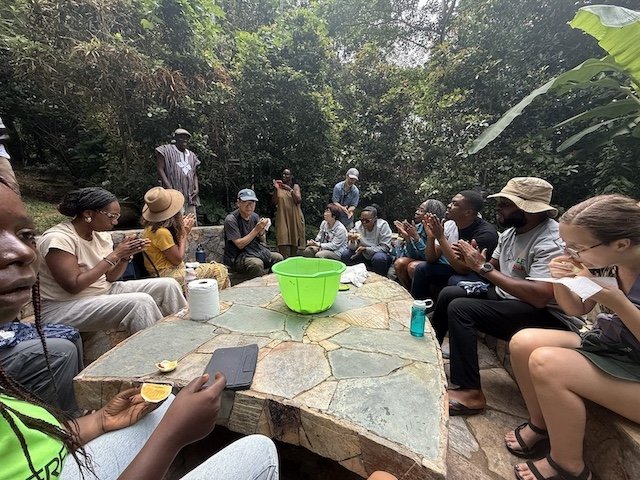
Sankofa Cohort at Anansekwae, Mampong, Akwapim
Ghana has taught us that our lives are intertwined with nature. We ask the trees:
May we use your roots for spices?
May we use your bark for dyes?
May we use your leaves to cure our bodies and your fruits for nourishment?
The trees always answer yes, and for this we must always be grateful.
Ghana reminds us of what humanity looks like. Here, no one is better than anyone else. The good of the community is valued over the good of the individual. People come together and are proud of who they are. “We are one Africa,” Yhaa told me when she shared that she was rooting for Morocco in the World Cup. In Ghana, there is no space for a large ego when people are more concerned about feeding the soul.
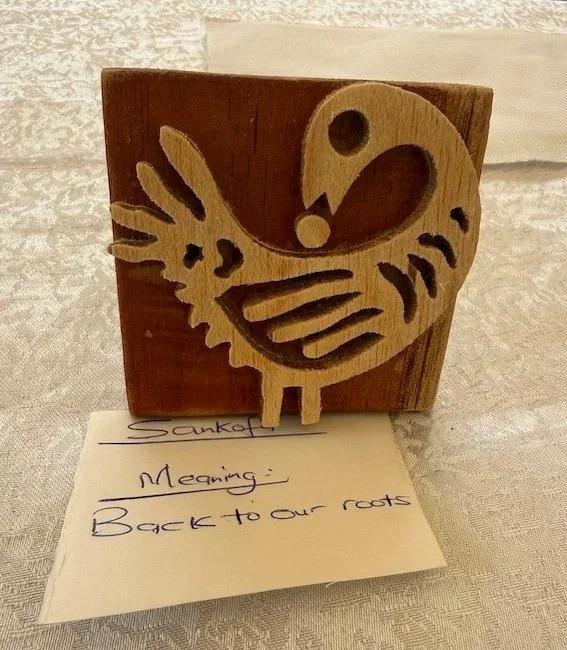
Sankofa- Adinkra symbol
Before we arrived in Ghana, the cohort voted on the Sankofa to represent our identities and values for our journey. This Adinkra motif symbolizes going back to the past and taking wisdom as we step into our futures. Candidly, I did not want to think about my past, but Ghana taught me that to heal and grow, I must come face to face with those memories.
According to Gloria Anzaldua the American philosopher and scholar, “”Knowing’ is painful because after ‘it’ happens I can't stay in the same place and be comfortable. I am no longer the same person I was before.”
As we reach the halfway point of our journey in Ghana, we have been humbled. We acknowledge all that we have acquired and experienced thus far. We accept that we are no longer the same people who first stepped into the Accra airport.
We will take what we have learned from Ghana, carry its seeds across seas, and spread these lessons to those who come after us.
Now is the time to write our own stories.
As Gertrude Fefoame shared, “It may not be easy, but it could be beautiful.”
Thank you, Ghana, for being our greatest teacher.
Medaase.
Precilla McCarthy teaches Grade 7 History and Language at Carroll School in Lincoln, Massachusetts, USA.