Turning Scattered Memories into One
It takes time to make fufu. Boiled plantain and cassava must be pounded together for a long time before they become one smooth, unified texture. In the finished fufu, you can no longer tell which part was plantain and which part was cassava. The green and the brown disappear, leaving only white.
This journey has been like making fufu.
My scattering memories of teaching mathematics at Okuapeman Secondary School in Akropong, Akwapim have slowly been brought together, blending and maturing into the philosophy of life that shapes who I am today.
I have reunited with old friends and met new ones. We have talked about familiar subjects and explored unfamiliar ones. We have learned together, shared experiences, and discovered emotions that words alone cannot fully express.
Whether in English, Japanese, Twi, Ga, or Hausa- words are inadequate to describe what I have experienced, what I have felt, and even who I have become.
Instead, it is dancing together, singing together, embracing one another, and meeting each other's eyes that awaken something deeper within me. At first, I thought these memories had been hidden somewhere inside my body. But perhaps they were never mine alone. Perhaps they were buried among the people with whom I experienced them.
To recover them, I need other human beings. I need real people—not even generative AI.
This journey has reminded me of the extraordinary value of human connection. We are not always efficient, and we are certainly not perfect. Yet we possess an energy and a power that no machine can replace. Each speaker I have listened to has spoken with confidence—not because every word was supported by formal evidence, but because their words were rooted in lived experience and personal truth.
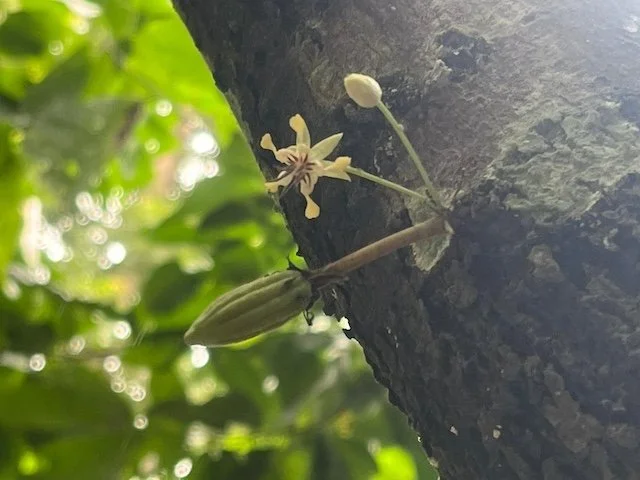
Cauliflory on a cocoa tree, Tafo, Eastern Region, Ghana
About forty-five years ago, I visited a cocoa farm in Ghana. I was astonished to see cocoa pods growing directly from the trunk of the tree, and I never forgot that sight.
Today, we visited the Cocoa Research Institute of Ghana (CRIG). The cocoa pods still grow from the trunk, just as they did all those years ago. This time, however, what surprised me was something different. I learned that cocoa beans are still dried under the sun, just as they were decades ago.
When I first came to Ghana in 1980 as a Japanese volunteer with the Japan International Cooperation Volunteers—the Japanese equivalent of the American Peace Corps—I was fascinated by the many differences I encountered: the food, transportation, concepts of time, the education system, the economy, Ghanaian English, customs, and daily life.
This journey, however, has taught me to notice what has remained unchanged.
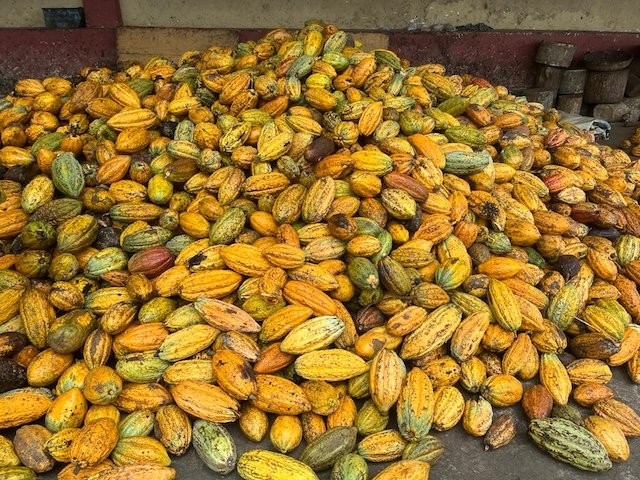
Harvested Cocoa pods
Cocoa beans are still dried under the sun. Vendors still balance pans of bottled water on their heads and skillfully sell bottles to drivers waiting at traffic lights. Along the roadside, people still sell furniture, tires, concrete blocks, potted plants, and school bags.
Most importantly, the bright, eager eyes of Ghanaian students have not changed.
Their hands still shoot into the air with questions. They remain curious, enthusiastic, and eager to understand. That spirit is exactly as I remember it from forty-five years ago.
At the CRIG Public School, I had the opportunity to share the story of Hideyo Noguchi with the Grade 8 students.
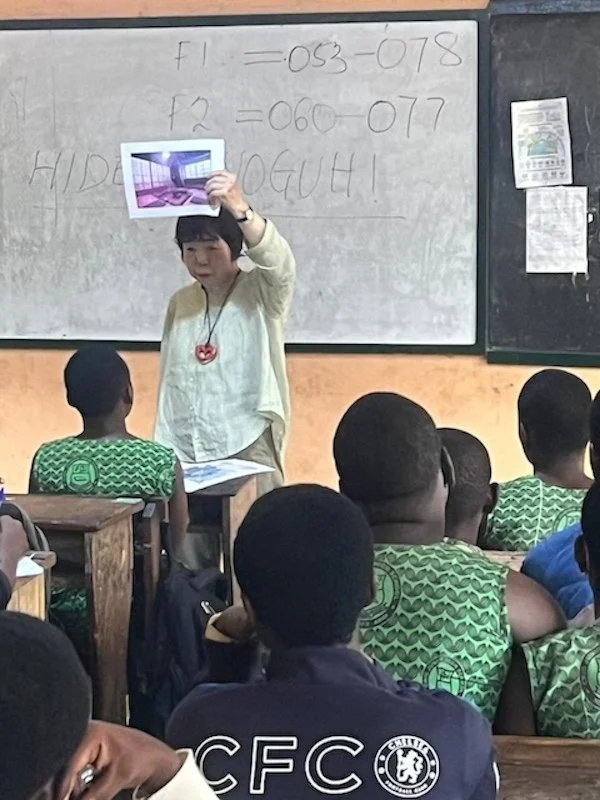
Teaching about Japanese bacteriologist Dr. Hideyo Noguchi
Hideyo Noguchi was one of Japan's most celebrated bacteriologists and medical researchers. Born into a poor farming family in 1876, he suffered severe burns to his left hand after falling into a hearth fire when he was only eighteen months old. At the age of fifteen, surgery restored much of the use of his hand, inspiring him to pursue medicine.
His mother encouraged him to study diligently, believing that because of his injured hand he could not depend on farming for his future. Through perseverance, he passed Japan's national medical licensing examination in 1900.
Noguchi's work eventually took him across the world. After gaining international experience in Tianjin, China, he continued his research in Philadelphia before joining the Rockefeller Institute in New York. In 1912, he married an American woman.
His research later led him to Ecuador, Peru, Brazil, and finally Ghana, where he came to study yellow fever. Tragically, in 1928, he contracted the very disease he was investigating and died in Accra at the age of fifty-one.
At that time, viruses could not yet be seen with the optical microscopes available to scientists. Today, his microscope is preserved at the Dr. Hideyo Noguchi Museum and Memorial Garden at Korle-Bu Teaching Hospital. His life reminds us of the courage required to cross borders in pursuit of knowledge and in service to humanity.
I chose to tell his story for two reasons. First, he represents a remarkable connection among Japan, the United States, and Ghana. Second, in many ways, his life reflects my own journey. But that is a much longer story, and I will save it for another time.
On July 9, I celebrated my seventy-first birthday.
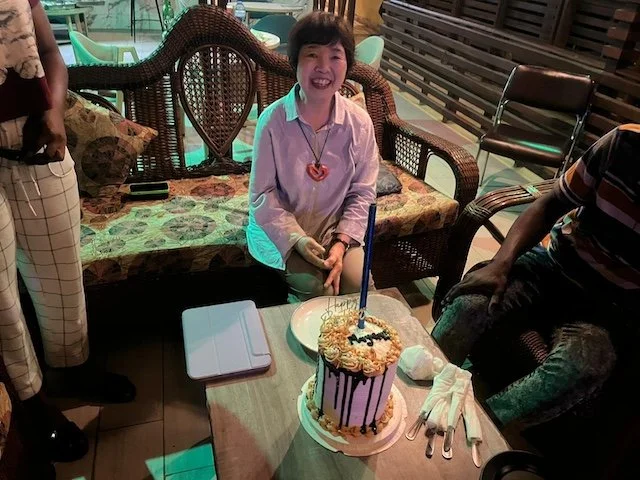
Sankofa Cohort 2026 surprise me with a cake on my birthday.
Despite our demanding schedule, my fellow cohort members surprised me with a beautiful birthday cake and a heartfelt celebration. It was a deeply touching moment that I will cherish for the rest of my life.
Thank you all for your kindness and thoughtfulness.
The hospitality of the Ghanaian cohort remains one of the greatest expressions of Ghanaian culture. It has not changed over the years. Without their generosity, I could never have experienced this journey so fully or so meaningfully.
Like fufu, my scattered memories are slowly being pounded together into one gracious whole.
Medaase.
Mayumi Kubota is Professor Emerita of Intercultural Communication at Kansai University in Osaka, Japan. She was also a Japanese Overseas Volunteer to Ghana.