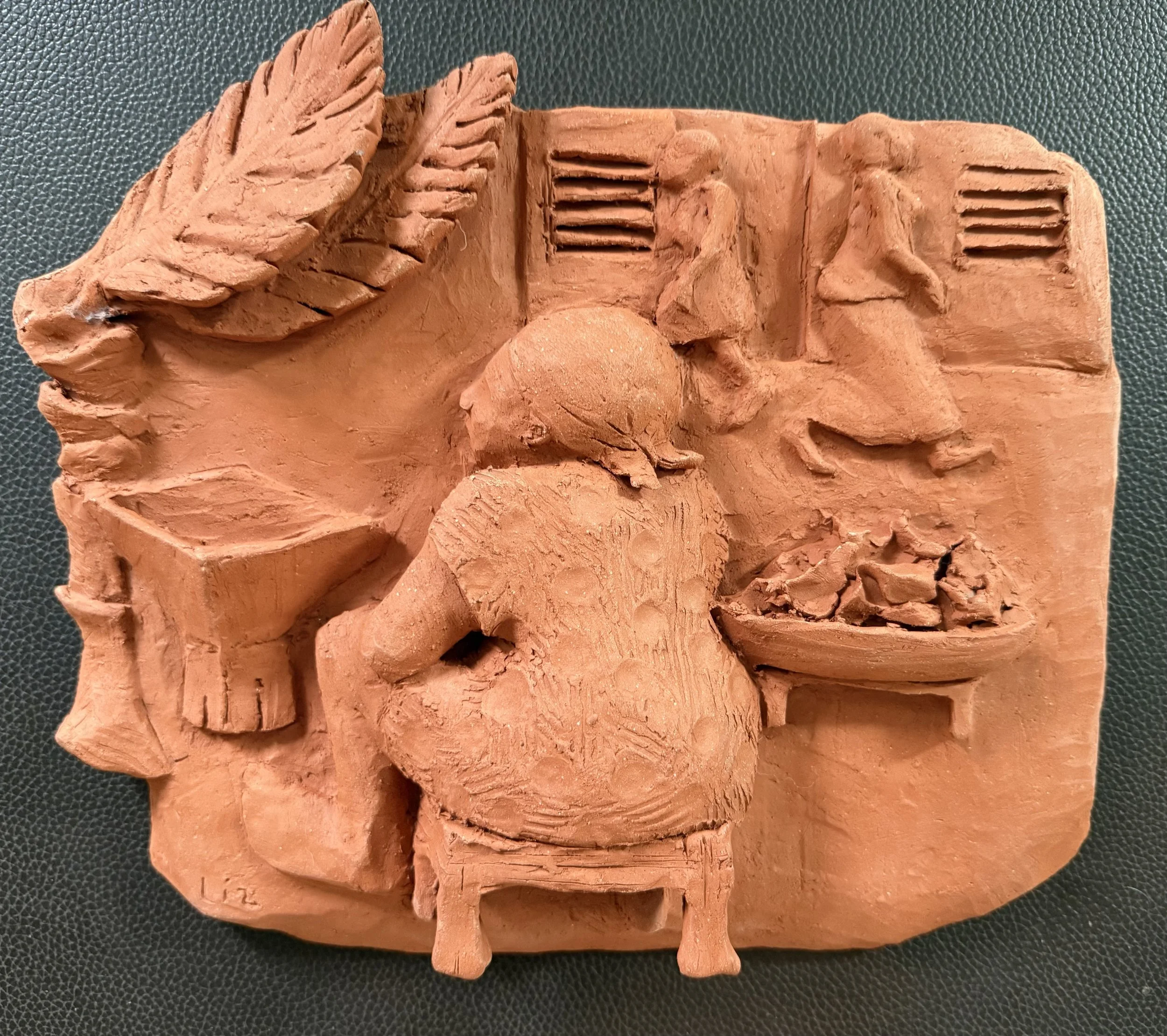
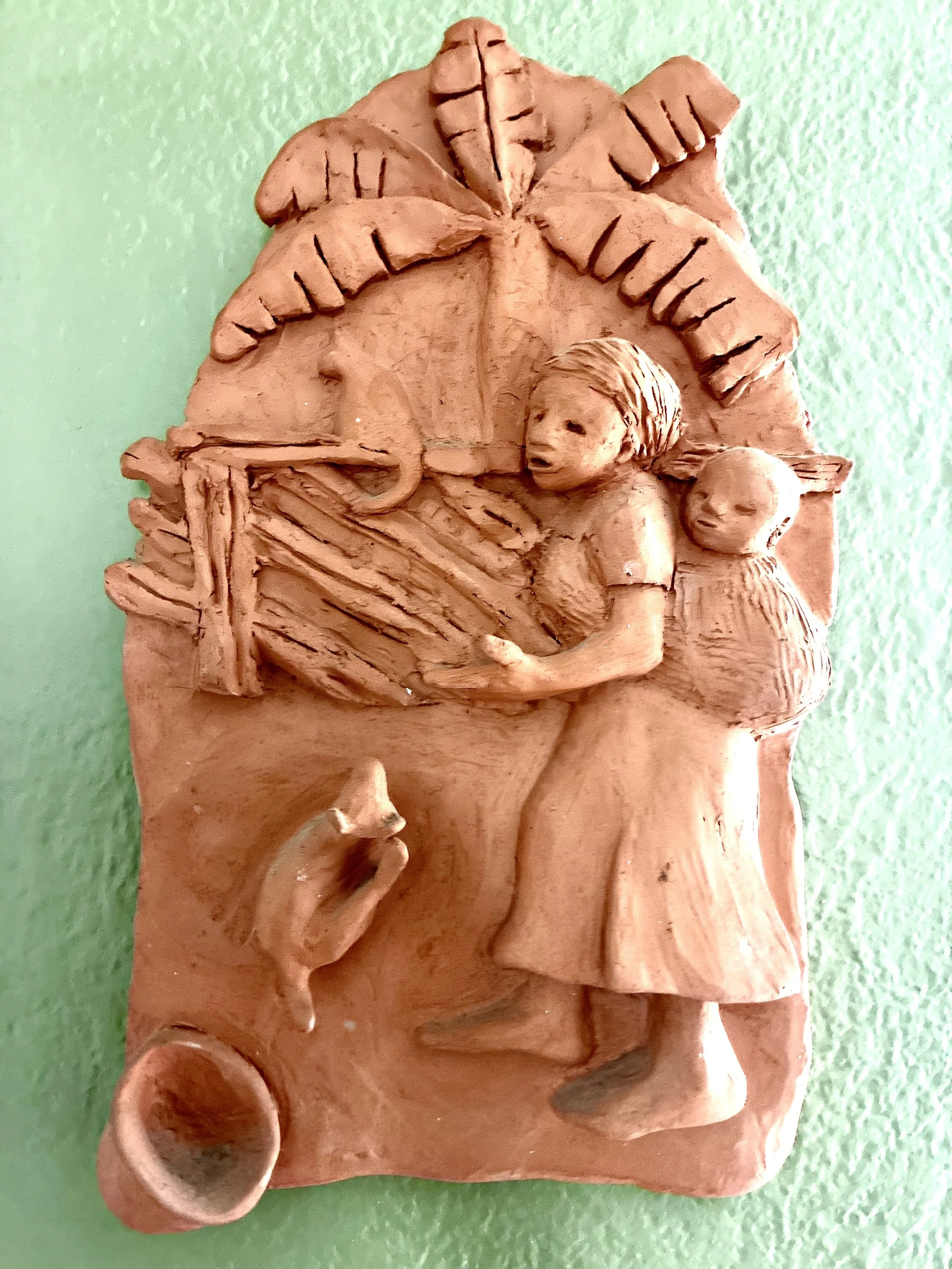
Elizabeth Updike Cobblah

Ghana 1985

The cabin erupts in applause

as Ghana Airways from London

touches down,

roars to a halt at KIA.

Heat, humidity and a tropical scent

engulf us on the tarmac.

Sweaty boisterous activity

in the crowded baggage claim,

then a wall of African faces.

Drivers, porters volleying their voices.

More sweat, more tropical air.

We have arrived.

Along the road to Bubuashie –

Head-bearing loads, babies on backs,

hawkers hawking, drivers beeping,

unregulated emissions,

fruit sellers, iccccce, icccce wattah, bells,

scissors, wooden boxes sounding out

their invitations to buy, to sharpen, to mend.

Low buildings. Human scale.

Concrete walls, zinc roofs, rust and dust,

banana trees and palms.

Necessary shade. Red earth. A mosque!

Chickens and goats. Hand painted sign boards.

The blue gate opens, more excitement,

our baby is scooped up, we are given water,

then breakfast.

Tete’s grandmother, mother and sisters

gave the most humbling welcome.

Tete’s father will pour libation later.

We settle in. The pace is slow and gentle.

I learn the value of water. A tank fills in the night,

some nights it doesn’t.

Boiled water chills in glass bottles,

A thermos of hot water awaits

Grandmother’s tea-time.

Bathing is from a bucket,

Key Soap and fishing net in hand.

We wash clothes outside on low stools

scrubbing, rinsing, wringing over large basins.

Early morning sounds

are sequenced -

first the Muslim call to prayer,

then the roosters

before metal buckets

hit the concrete, receiving water from the tank

to fill the barrels in the house,

then the sound of sweeping begins.

The young and strong start the day this way.

The smells of cooking

- onion, garlic, ginger, pepper - soon follow.

I walk down the red earth road

to a small market with my basket.

Kids run past with wheels on sticks,

small chicks peck around a hen’s feet,

laundry is hung,

banku is stirred over an open coal fire.

Greetings are exchanged along the way.

I marvel at my proximity to lives being lived

in open passageways, on roadsides,

-the intimacy, effort and intricate web of living here.

I return with a tea towel draped over my purchases,

as instructed by my sister-in-law.

Tomatoes, oil, soap, matches, bread.

Bean stew and fried plantain

have been dished into my family’s ceramic container.

No polythene bag. No polystyrene container.

Chilled water in a repurposed glass bottle awaits me.

Plastic wasn’t choking Ghanaian gutters in 1985.

And there were many, many more trees!

But Ghanaian generosity, warmth and spirit

of goodness continue - society’s anchor and oars.


Elizabeth Updike Cobblah Is a retired art teacher and a board member of WTIG
Barbara Beachley

Akwaaba: From Being a Stranger to Being at Home

Barbara Beachley

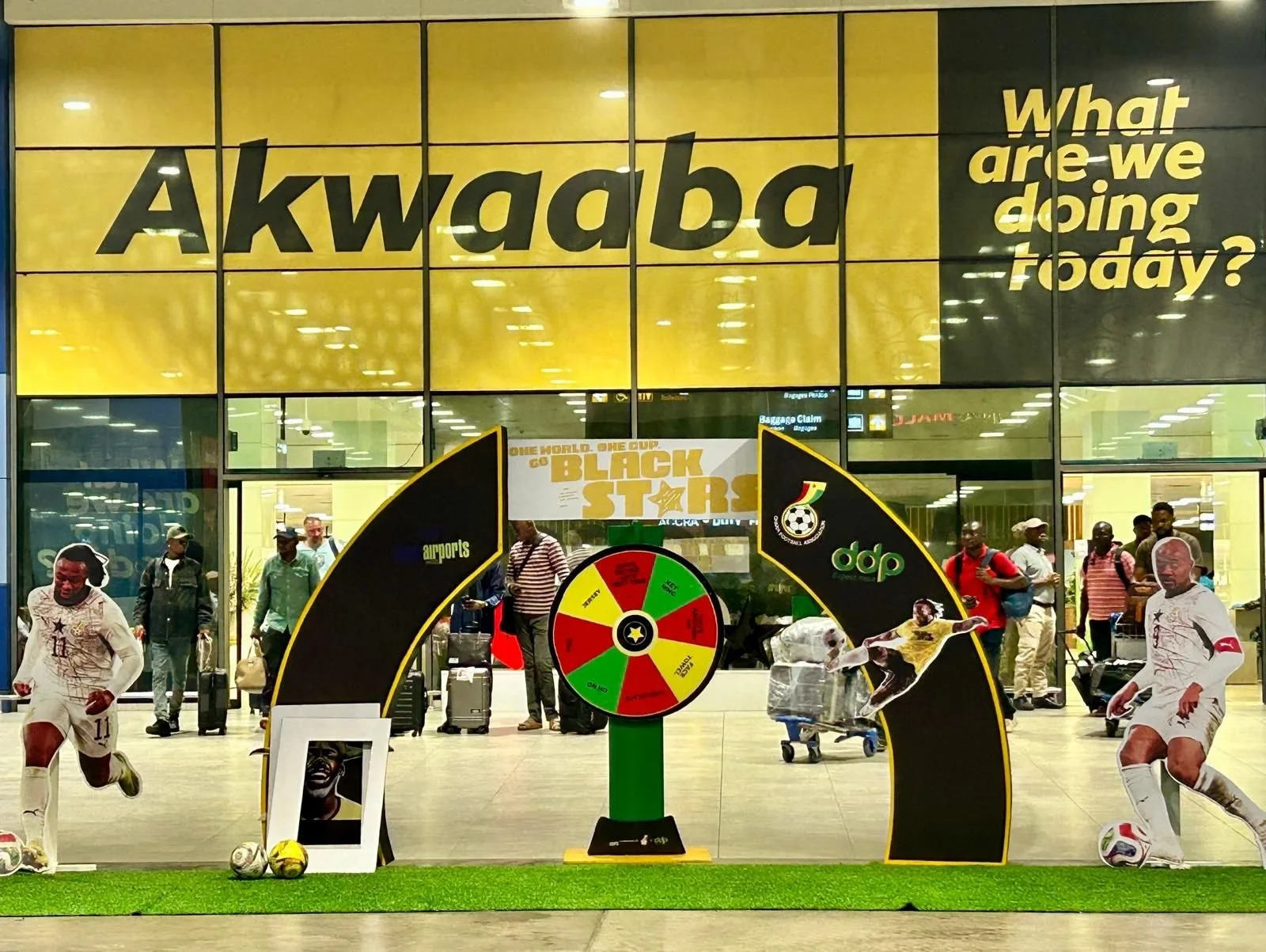
The term “akwaaba,” the first thing you see on a large sign at the Accra airport, technically means “welcome,” but experiencing akwaaba goes far deeper than the word itself. When I stepped out of the airport in Accra, I was overjoyed. Waiting outside were Dela and Kwasi, who had become dear friends during the two weeks we spent together last year. As soon as they saw my co-leader Denise and me, they jumped up, waving their arms, then hurried toward us with broad smiles and warm embraces. In that instant, I didn’t feel like a visitor returning to a foreign country. I felt like I was coming home.

There is something about Ghana, and about the Ghanaian people I have had the honor to meet, that creates that feeling. Ghanaians often say it is part of their culture to be good hosts, but it is so much more than hospitality. The welcome I have experienced here is authentic. There is no sense that people are simply being polite or fulfilling a social obligation. They genuinely want you to know that you belong, that you are home.

Tete Cobblah, the founder of the Witness Tree Institute, shared an expression that has stayed with me: the stranger is the most important person in the room. The person who is unfamiliar, uncertain, or outside the circle deserves our greatest attention. Instead of expecting the newcomer to find their place, the community makes a place for them.

That philosophy reveals itself not just in words but in rituals.

After arriving at the home where we are staying, Dela invited us to sit at the table. We were given a cold bottle of water and officially welcomed. Dela and Kwasi said how happy they were that we had arrived safely and how much joy it brought them to have us there. It gave me the opportunity to pause, receive their welcome in my heart, and then share my own genuine gratitude and joy in return.

It was such a simple moment, yet taking that pause to connect had a profound impact on me.

Today, during a keynote, the Reverend Professor Pashington Obeng, who was kind enough to remember me and greet me warmly, explained that this ritual has deep cultural significance. Before a visitor is ever asked their purpose for coming, they are first offered water. Only after the water has been accepted does the conversation continue. Professor Obeng explained that in Ghanaian culture, the host assumes responsibility for the visitor’s well-being: physically, socially, and emotionally. The way a person treats strangers is a reflection of their character.

I couldn’t help but think about the character of my own country and the ways we are currently treating those who arrive at our doors.

Professor Obeng also reminded us that hospitality carries a responsibility for the visitor as well. The visitor often has wide, bright eyes, he said, but does not truly see. As visitors, it is our responsibility to seek first to understand before being understood. Otherwise, we risk judging what we observe before we have the context to make sense of it. 

That is one of the central purposes of the Witness Tree. We are called to become witnesses to our shared humanity, not by pretending our differences do not exist, but by seeing one another more fully because of them.

In that brief welcome ritual, nothing needed to be accomplished. There was no agenda and no rush to move on to the next thing. We simply acknowledged one another’s presence and expressed gratitude that we were together. It struck me how rarely I allow space for moments like that. At home, greetings are often squeezed between appointments, emails, and the next item on my to-do list. Yet what could possibly be more important than human connection?

Ghana invites me to move at a different pace. It reminds me that welcoming someone is not simply opening a door and saying kind words. It is creating space for them to feel seen, valued, and connected to others. That sense of belonging changes my perspective and the way I participate. When I’m not worried about finding my place, I can be present. I notice the beauty around me. I listen more carefully. I connect more deeply.

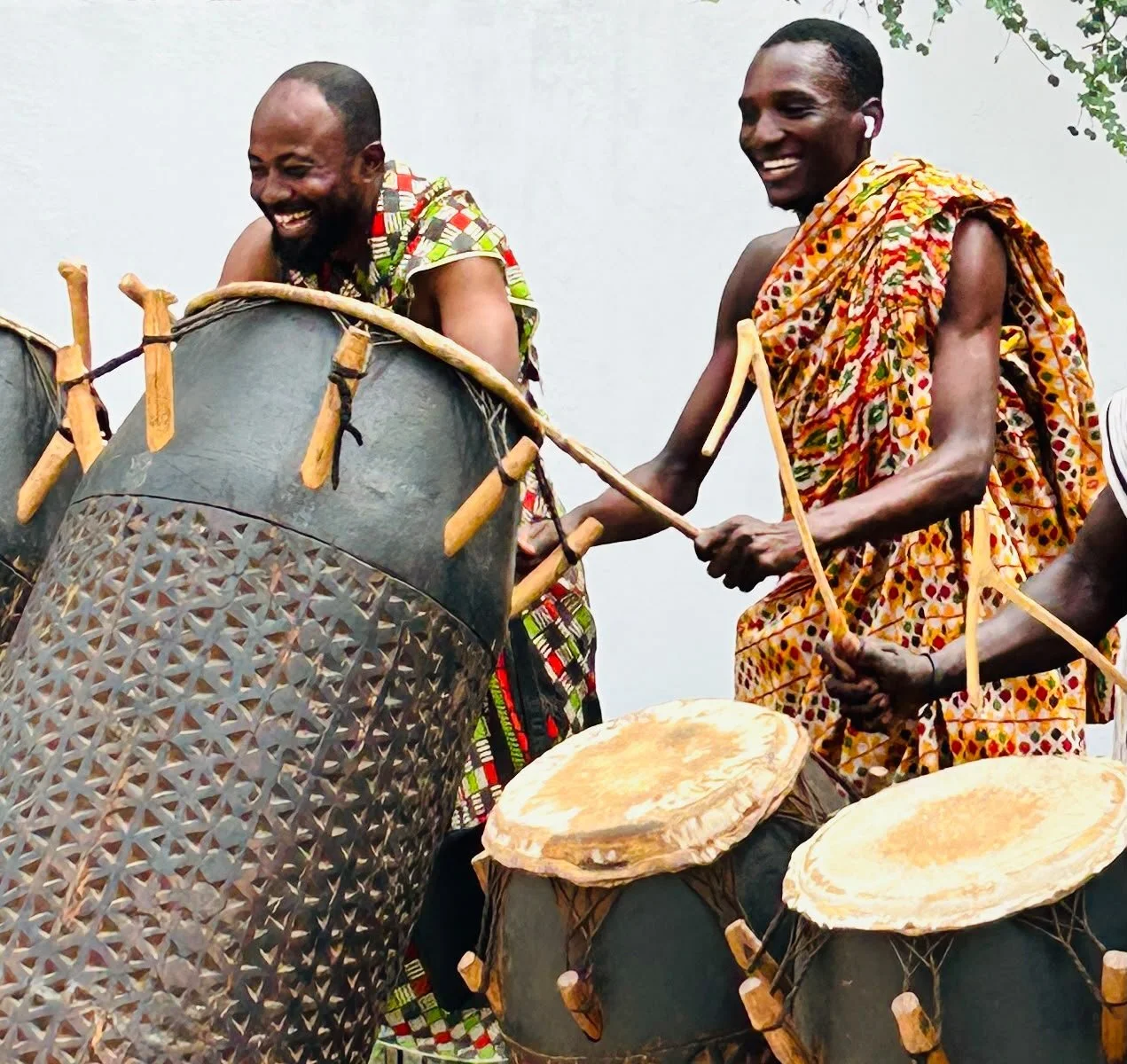
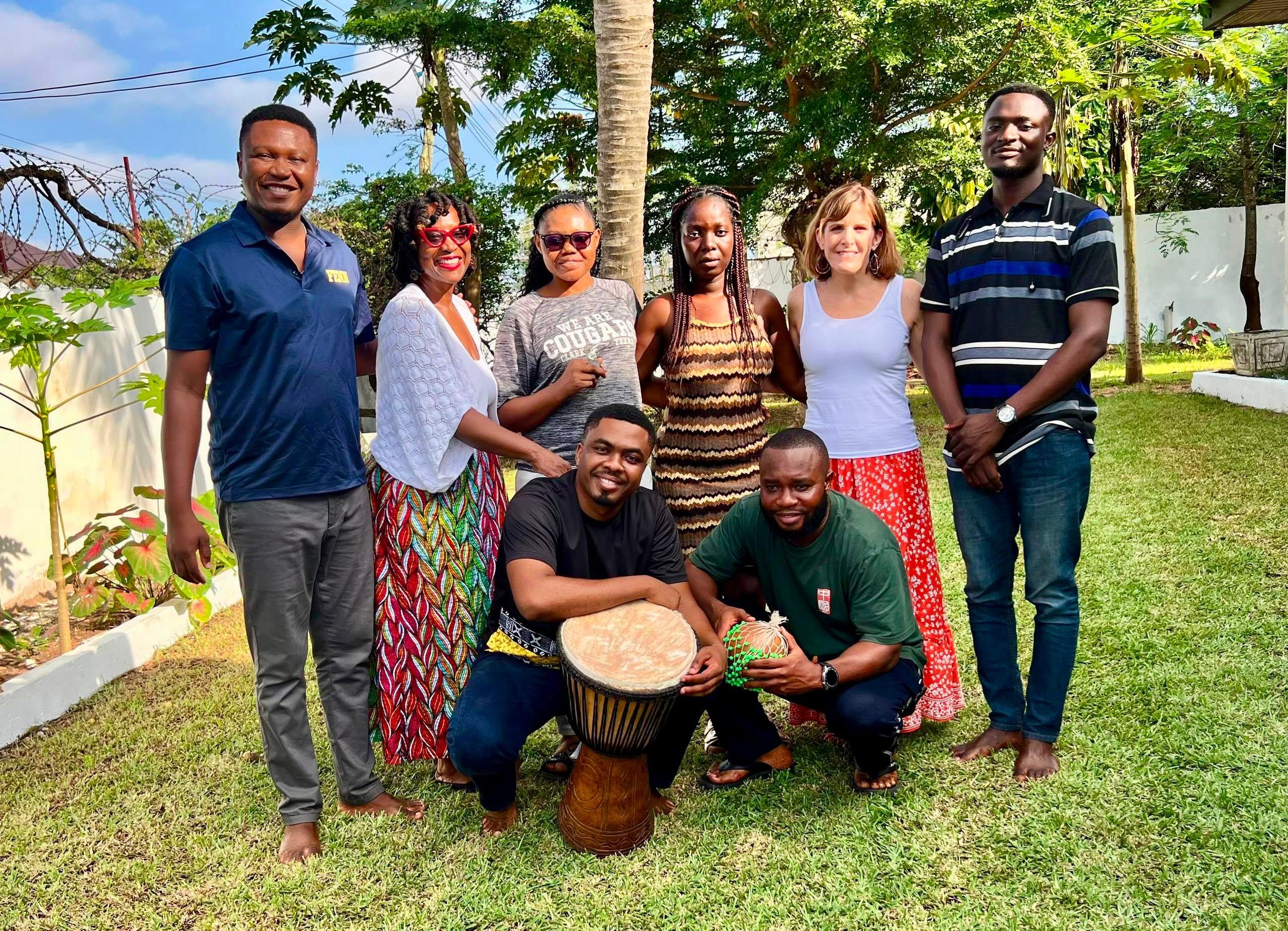
Perhaps that is also why the sense of community here feels so different. There is a joy on people’s faces that is difficult to describe. I hope the photographs I have shared, especially of the two drummers, capture even a fraction of it. It is not that hardship, suffering, or poverty do not exist. They do, alongside world-class research institutes, universities, museums, and theaters. But what feels different is that no one seems expected to carry life alone.

Another expression I have heard repeatedly here is, “I am because we are. We are because I am.” It is a reminder that our lives are intertwined and that our flourishing depends upon one another. I believe that is true everywhere, but I do not believe we acknowledge or live that truth in the United States, where we instead “pull ourselves up by our own bootstraps.” No one actually does that, of course, but saying so diminishes the contributions of others that inevitably led to any one individual’s success.

As I reflect on what I have experienced here, I cannot help but think about what this means for school leadership. Leadership is not simply about setting direction or managing systems. It is about taking the time to know teachers and staff, to be genuinely curious about who they are, to listen with humility, and to ensure they know they are valued. After all, they are the ones who shape the daily experiences of students. When educators experience that same sense of belonging, how much more likely they are to create it for the children in their care!

Perhaps that is why returning to Ghana feels less like traveling and more like coming home. Not because it is familiar, but because the people I have met here embody a spirit of joy, generosity, and community that I did not realize I was yearning for until I experienced it.

As I begin another journey here, I find myself wondering: What might our communities, our schools, and our countries become if we treated every stranger as the one most in need of our attention? What might change if we all sought to understand before seeking to be understood?

Barbara Beachley is.a former head of school, WTIG alum and co-leader. 

Tete Cobblah- WITNESS TREE INSTITUTE 2026 BLOG

A LETTER TO COHORT SANKOFA

“…..remain curious and respectful. To listen not only to others, but to the quieter voices within us, with purpose. Listen to the air between words and breaths.”

Tete Cobblah

Dear Friends,

As you embark on this journey, I will be with you from afar in Massachusetts. However, I am compelled to say Akwaaba because I will be close to you in spirit and through technology. As I experience excitement and hope for you, certain words and phrases come to me as I think about some commentary and suggestions for this cohort.

Our world: I find myself holding on to two truths at once. The goal of the Witness Tree Institute is to seek the best in humanity—to learn, to listen, to witness joy, creativity, memory, and hospitality across this land that receives all of you. This you will find. You will find out how hospitable the people of Ghana are. It fills me with pride that despite the many changes my native land has undergone, that spirit of hospitality and warmth remains.  And yet, I cannot ignore the very conditions that threaten the future of our shared human family, or the hearts of our children, our students and the generations to come. Alternatively, I cannot unsee the pain of despair, anger, fear, sorrow in the videos showing flooding of many parts of Accra and greater Accra recently; the images of death and destruction are still on my mind. As I wrote in our last newsletter, our hearts go out to the children, women, and men who have suffered the pains of emotional, psychological and physical loss.

The message of Witness Tree is simple, even if the work is not: if we are to attain even a measure of peace and wholeness, we must learn to hold hands across difference and feel each other’s heartbeats, as we are, quite literally, made from the same cloth. We cannot do without one another. Ubuntu Philosophy explains that "Belonging is the culture of shared humanity. We are made of the same fabric, meaning no one is an island, and no one is an outsider by nature." So, the pain of Ghana is ours too.

A Different Mirror: During this program in Ghana, remind yourself that the world you come from doesn’t define the rest of humanity—a reminder that no single place contains all truth, all sorrow, or all hope. Every land sings a part of the same unfinished human hymn- a song of hope and peace.

Listen: In a world increasingly shaped by reductive conversations and hardened arguments—as Kara Swisher reminds us—we hope you are challenged to resist simplification. To embrace what is new and different. To remain curious and respectful. To listen not only to others, but to the quieter voices within us, with purpose. Listen to the air between words and breaths.

Learning deeply: There is a kind of learning that requires openness without guilt, reflection without paralysis. Whoever you are, your identity will shape how you interpret Ghana, her history and culture. We are called to explore—even to step toward and touch what is in shadow and what is not yet understood. This experience may allow you to merge with more hope than determination to become an agent of change.

Questions: This journey will ask questions of us, especially as we experience joy, uncertainty, pride or even guilt. Why do “empty” historical places like Elmina sometimes lend themselves to reflection, contemplation and presence? In a world filled with noise, how do we move toward deep focus on what matters most? And how do we respond, with grace and love, to systems where wealth can distort belonging and even attempt to own the souls of countries and people? And perhaps most importantly, ask yourself: What stories do you hold on to when you are feeling displaced? What of yourself has emerged? Let those questions travel with you.

Gratitude: From experience, I offer this gentle guidance: find a way to ground yourself in vulnerable moments on this trip. Look around you each day and offer gratitude. Draw strength from the fact that you are loved, and that you are held within a wider human story. Keep your eyes and heart open for grace in simple things.

Prayers: We begin, as we always do in Ghana, with prayer and offering of libation—words that connect the seen and unseen, the living and the remembered:

Yɛfrɛ yɛn adɔfoɔ nkaeɛ ne wɔn honhom a ɛda so te ase—wɔn a wɔka yɛn ho nnɛ ne wɔn a wɔadi yɛn anim. Momma wɔn agyapadeɛ nnyini wɔ yɛn mu sɛ ɔdɔ a ɛnsa da.

Momma wɔn honhom nhyɛ yɛn den wɔ amanehunu mu, na wɔmma yɛn akoma mmrɛ. Na sɛ abufuo anaa ɔsɔretia hyia yɛn a, momma yɛde ayamye, fafiri, ne mmɔborɔhunu mmua.

Momma saa nhyiam yi nhyɛ aseɛ wɔ nkaeɛ, nkabom, obu, ne asomdwoe mu. Akwaaba. Momma yɛnhyɛ aseɛ.

We call upon the living memory and enduring presence of our beloved ones—those who walk with us today and those who have gone before us.

May their legacy grow within us as a lasting harvest of love, giving us strength in hardship and hope in sorrow.

When we face anger or opposition, may we answer not with resentment, but with generosity, forgiveness, and mercy.

May this gathering begin in a spirit of remembrance, strength, community, respect, and peace. Akwaaba! Let us begin.

 -Tete Cobblah is Founder and Director of Witness Tree Institute of Ghana